





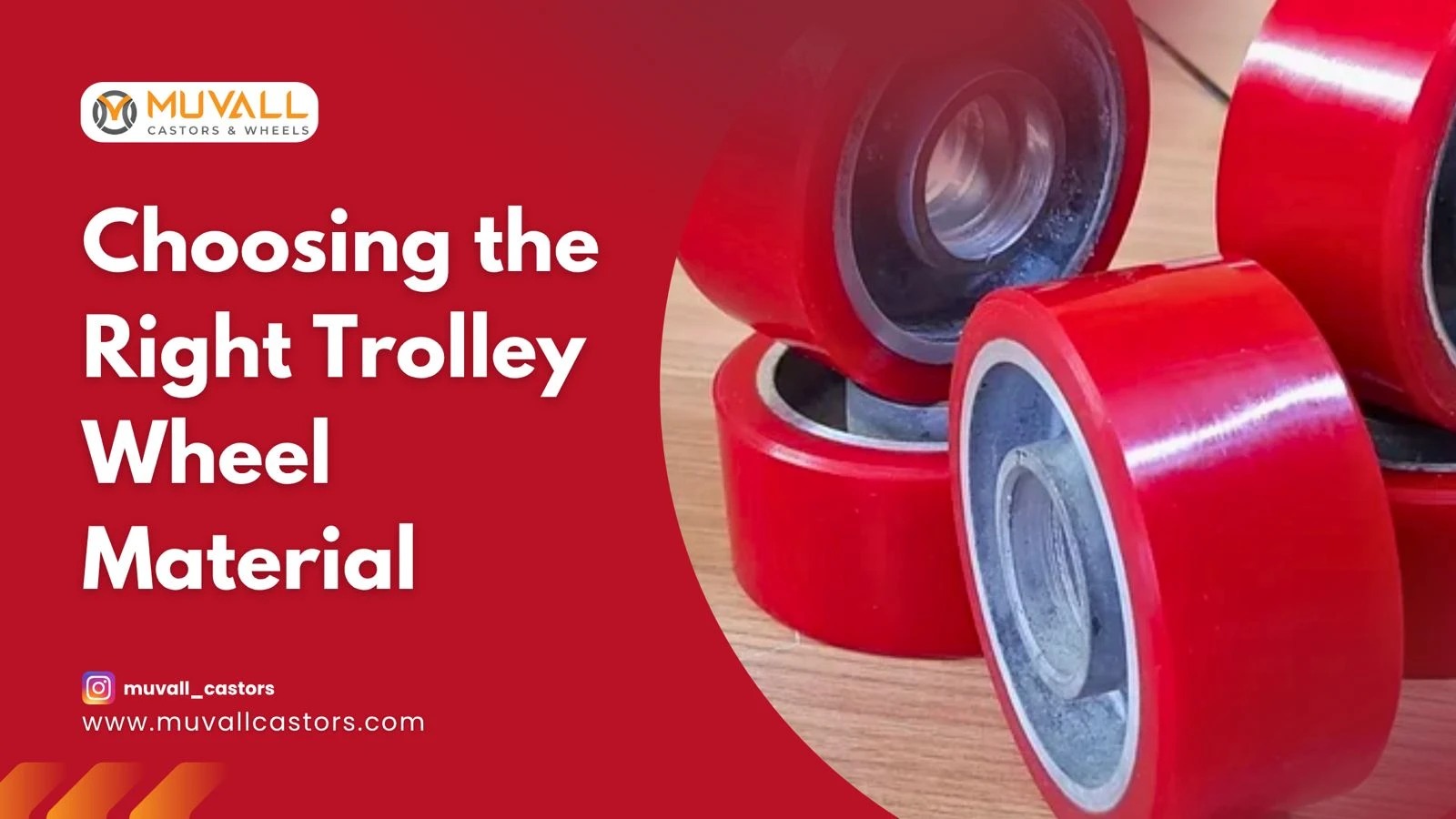
Choosing the Right Trolley Wheel Material: PU vs Nylon vs Rubber vs Cast Iron — When Each Actually Makes Sense
If you're replacing wheels on a warehouse trolley or specifying wheels for a new platform truck, the material choice matters more than most buyers realize — not because one is universally "best," but because each material makes specific trade-offs that either help or hurt your particular application.
This post walks through the five trolley wheel materials you'll actually encounter in Indian industrial supply: polyurethane (PU), nylon, rubber, cast iron core polyurethane (PUCB), and TPR. For each one, we'll cover load capacity, floor protection, noise, cost, and when you should actually specify it instead of the others.
Polyurethane (PU) — The default for most warehouse and factory trolleys
What it is: A synthetic elastomer with a tread hardness of 92–95 Shore A. The tread is bonded or bonded-and-cast over a steel or aluminium hub.
Load capacity: Depends on wheel size and hub design, but typical Muvall PU wheels carry:
- 100 mm diameter: 150–200 kg per wheel
- 150 mm diameter: 250–400 kg per wheel
- 200 mm diameter: 400–600 kg per wheel
(These are static loads. Apply a 1.5–2.0× safety factor for real-world trolleys.)
Floor protection: Excellent. PU tread doesn't mark epoxy, polished concrete, tile, or vinyl. It won't chip or delaminate unless the polyurethane itself fails — which on a good wheel (sealed double ball bearings, proper bonding) takes years.
Noise: Quiet — roughly 65–70 dB when rolling at normal speed. Acceptable in warehouses, hospitals, and commercial spaces.
Grip: Good — better than nylon on smooth floors, especially when the floor is slightly oily or dusty. Important for operators on sloped areas.
Environment: Works in most conditions. PU degrades under prolonged UV exposure (so outdoor-only use isn't ideal), and it can soften slightly in very hot environments (>60°C sustained). Resistant to most oils, grease, and light solvents; aggressive chemicals and strong solvents can eventually soften the tread.
Cost: Mid-range. A 150 mm PU wheel in Muvall's PSTS or PSTP range costs roughly ₹800–1500 depending on specification.
When to specify PU:
- You have an epoxy, polished concrete, or tiled floor and want to keep it unmarked
- Rolling noise matters (hospitals, retail spaces, hotels)
- You want balanced performance across load, durability, and cost
- The trolley will run mostly indoors
You don't have extreme environmental challenges (sustained heat, aggressive chemicals)
Muvall ranges with PU wheels: PSTS, PSTP, PSTIL (pressed steel); MFTP (fabricated steel); HMP, HDP, TTB (heavy-duty forged).
Nylon — When you need to carry a very heavy load or your floor is already damaged
What it is: Polyamide thermoplastic, typically cast in a single piece around a precision bore. Hardness ~80 Shore D (roughly equivalent to hard plastic gears or engineering parts — much harder than PU).
Load capacity: Significantly higher than PU at the same size:
- 100 mm diameter: 250–350 kg per wheel (vs 150–200 for PU)
- 150 mm diameter: 400–600 kg per wheel (vs 250–400 for PU)
200 mm diameter: 600–1000 kg per wheel (vs 400–600 for PU)
The reason: nylon barely deforms under load, so it doesn't lose capacity the way a PU wheel does when the tread compresses.
Floor protection: Poor to negligible. Nylon is harder than most floor coatings. On an epoxy floor, nylon wheels can leave grey streaks and, over months or years, create small indents if the trolley parks in the same spot. On vinyl or polished concrete, the marking is less visible but still happens. On bare concrete, floor protection is a non-issue.
Noise: Loud — typically 80+ dB. A nylon-wheeled trolley rolling across concrete sounds distinctly different (and louder) than a PU-wheeled one. In hospitals, 24-hour warehouses, or any sound-sensitive environment, this becomes a real problem quickly.
Grip: Lower grip than PU on smooth or slightly oily floors. Nylon rolls "slippier." On slopes or inclines, operators often have to use more force to hold or control the trolley.
Environment: Excellent. Nylon resists oils, solvents, UV, heat, and moisture far better than PU. A nylon wheel in a foundry, a chemical plant, or an outdoor yard will outlast a PU wheel.
Cost: Slightly cheaper than PU per wheel (maybe ₹600–1200), but often this cost saving disappears when you factor in the cost of re-coating or resurfacing a damaged epoxy floor after a couple of years of nylon wheels.
When to specify nylon:
- Your trolley carries loads above 600 kg per wheel (requiring nylon's higher capacity)
- Your floor is bare concrete, bare steel, or already damaged (floor protection isn't a priority)
- The trolley operates in harsh environmental conditions (oil, solvents, heat, water)
- Noise isn't a constraint (foundries, outdoor yards, rough warehouses)
- You don't have a beautiful epoxy coating to protect
Muvall ranges with nylon wheels: PSTS, PSTP (available with NYB wheels); MFTP, HMP, HDP, TTB (all available with CNYB wheels).
Cast Iron Core Polyurethane (PUCB) — When you need high load capacity without sacrificing floor protection
What it is: A polyurethane tread bonded to a cast iron wheel centre. The cast iron gives structural strength and load capacity; the PU tread provides floor protection and ride quality.
Load capacity: Sits between pure PU and nylon:
- 150 mm diameter: 400–600 kg per wheel
- 200 mm diameter: 600–1000 kg per wheel
The key: the cast iron centre is stiffer, so the wheel deforms less under load. For a given wheel diameter, PUCB carries more load than PUB (solid polyurethane) while still protecting the floor.
Floor protection: Excellent — as good as solid PU. The tread is still polyurethane, so it won't mark epoxy, tile, or polished concrete.
Noise: Quiet, like PU — 65–70 dB.
Grip: Good — same as solid PU. Better than nylon on smooth or oily floors.
Environment: The weak point is the bond between the PU tread and the cast iron centre. If the bonding (chemical or mechanical) is poorly done, the tread can delaminate under heat or oil exposure. A well-bonded PUCB wheel (which is what Muvall supplies) resists delamination for years. A poorly bonded wheel might delaminate within months in an oily or hot environment.
Cost: Mid-to-high. A 200 mm PUCB wheel costs roughly ₹1200–1800, more than either pure PU or nylon alone. But the performance justification is real.
When to specify PUCB:
- You need load capacity above what solid PU can deliver, but floor protection matters
- The trolley operates in a modern auto plant, pharmaceutical facility, or food plant with epoxy floors and heavy engine or equipment movement
- You want balanced performance: high load capacity, floor protection, and quiet operation
- The environment is moderately industrial (some heat, some oil exposure, but not extreme chemical aggression)
Muvall ranges with PUCB wheels: MFTP, HMP, HDP (up to 1000 kg per wheel at 200 mm), TTB (up to 2000 kg per wheel at 200 × 75 mm).
Rubber — For silent, shock-absorbing movement in delicate spaces
What it is: Natural or synthetic rubber, either solid-cast or bonded to a hub. Hardness typically 60–75 Shore A — softer than PU.
Load capacity: Lower than PU or nylon:
- 100 mm diameter: 100–150 kg per wheel
- 150 mm diameter: 150–250 kg per wheel
Rubber wheels deform significantly under load, which reduces their effective load-carrying ability compared to harder materials.
Floor protection: Excellent — softer than PU, so it's even gentler on delicate floors.
Noise: Very quiet — 60–65 dB, lower than PU. The softness absorbs vibration, making the trolley feel smoother to push.
Grip: Excellent on smooth floors and even better on slightly sloped surfaces.
Environment: Rubber degrades under UV (outdoor use), oils (especially synthetic and aromatic solvents), and heat. Not suitable for long-term exposure to strong chemicals.
Cost: Variable. Natural rubber is cheaper; synthetic (EPDM, SBR) is more chemical-resistant but costs more. Typical range ₹400–1000 per wheel.
When to specify rubber:
- You have a light-duty trolley (under 200 kg total load)
- Noise and comfort matter (hospitals, hotels, retail, offices)
- The floor is already slightly uneven or you're moving goods that are shock-sensitive (electronics, delicate items)
- The environment is clean and mostly indoors
- You don't need high load capacity
Muvall ranges with rubber wheels: Limited — rubber is less common in heavy-duty industrial trolleys. We tend to recommend TPR (below) for the same applications because TPR offers better chemical resistance.
Thermoplastic Rubber (TPR) — The modern replacement for traditional rubber
What it is: A blend of rubber and thermoplastic, offering rubber-like softness with plastic durability. Hardness 70–85 Shore A.
Load capacity: Similar to rubber — not suitable for heavy loads:
- 100 mm diameter: 120–180 kg per wheel
- 150 mm diameter: 180–300 kg per wheel
Floor protection: Excellent — soft and non-marking.
Noise: Very quiet — 60–65 dB, similar to rubber.
Grip and shock absorption: Excellent.
Environment: Better than rubber. TPR resists oils, solvents, and UV better, making it suitable for mixed indoor/outdoor use. Not suitable for extreme chemical exposure, but much more robust than natural rubber.
Cost: Similar to good-quality rubber — ₹500–1200 per wheel.
When to specify TPR:
- You want quiet, smooth operation with good floor protection
- The trolley is light to medium duty (up to ~300 kg per wheel)
- The environment includes some light chemical exposure or outdoor time (which rules out rubber)
- You're in a hospital, commercial kitchen, hotel, or retail environment
Muvall ranges with TPR wheels: Available as custom options; most commonly specified through our PSTS and PSTP ranges.
Elastic Rubber (ELRB) — Maximum softness for very delicate floors or applications
What it is: A soft, elastic rubber formulation designed to absorb vibration and provide maximum shock absorption. Hardness typically 60–70 Shore A — the softest standard trolley wheel material.
Load capacity: Lower than TPR or rubber:
- 100 mm diameter: 100–140 kg per wheel
- 150 mm diameter: 140–220 kg per wheel
Floor protection: Exceptional — the softest material means it won't mark or indent even polished or delicate flooring.
Noise: Very quiet — 55–60 dB, the quietest of all trolley wheel materials.
Grip and shock absorption: Excellent — best-in-class for ride comfort.
Environment: Similar limitations to rubber — degrades under UV and strong solvents.
Cost: ₹600–1400 per wheel depending on size.
When to specify ELRB:
- The floor is very delicate or has already been damaged
- Vibration and shock matter (transporting sensitive instruments, medical equipment, artwork)
- Silent operation is critical
- Load capacity is not a constraint
Muvall ranges with ELRB wheels: Available as custom specifications for hospital stretchers, medical carts, and sensitive-goods trolleys.
Quick comparison table
| Property | PU | Nylon | PUCB | Rubber | TPR | ELRB |
|---|---|---|---|---|---|---|
| Load capacity (150 mm) | 250–400 kg | 400–600 kg | 400–600 kg | 150–250 kg | 180–300 kg | 140–220 kg |
| Floor protection | Excellent | Poor | Excellent | Excellent | Excellent | Excellent |
| Noise level | Quiet | Loud | Quiet | Very quiet | Very quiet | Very quiet |
| Grip | Good | Fair | Good | Excellent | Excellent | Excellent |
| Cost per wheel | Mid | Low | High | Mid | Mid | Mid–High |
| UV resistance | Poor | Excellent | Moderate | Poor | Good | Poor |
| Chemical resistance | Moderate | Excellent | Moderate | Poor | Good | Poor |
| Best for | General industrial | Heavy loads, bare floors | Heavy + epoxy floor | Light, delicate | Light–medium, mixed environment | Ultra-delicate floors |
The real-world decision framework
Don't pick the "best" wheel material. Pick the one that solves your specific constraints:
What's your actual load per wheel? (Remember: divide total load by 3, not 4, and apply a 1.5–2.0× safety factor.)
What floor do you have? Epoxy or polished concrete → PU, PUCB, TPR, or ELRB. Bare concrete or steel → nylon is viable. Mixed or damaged → nylon or PUCB.
Is noise a constraint? Hospitals, retail, hotels → avoid nylon. Choose rubber, TPR, ELRB, or PU.
Do you have environmental challenges? Oil, solvents, heat, outdoor use → nylon or TPR. Clean environment → PU, rubber, or ELRB.
- What's your budget? Nylon is cheapest per wheel, but the cost of re-coating an epoxy floor after 2 years wipes out any saving.
Bottom line
Muvall stocks all five of these materials across our ranges. The recommendation you get isn't the one that fits our inventory — it's the one that actually solves your problem. PU is the most common choice for good reason (balanced performance, floor protection, cost). But if your trolley is moving 1000+ kg, or if your floor is bare concrete, or if you're in a hospital, a different material is the right answer.