





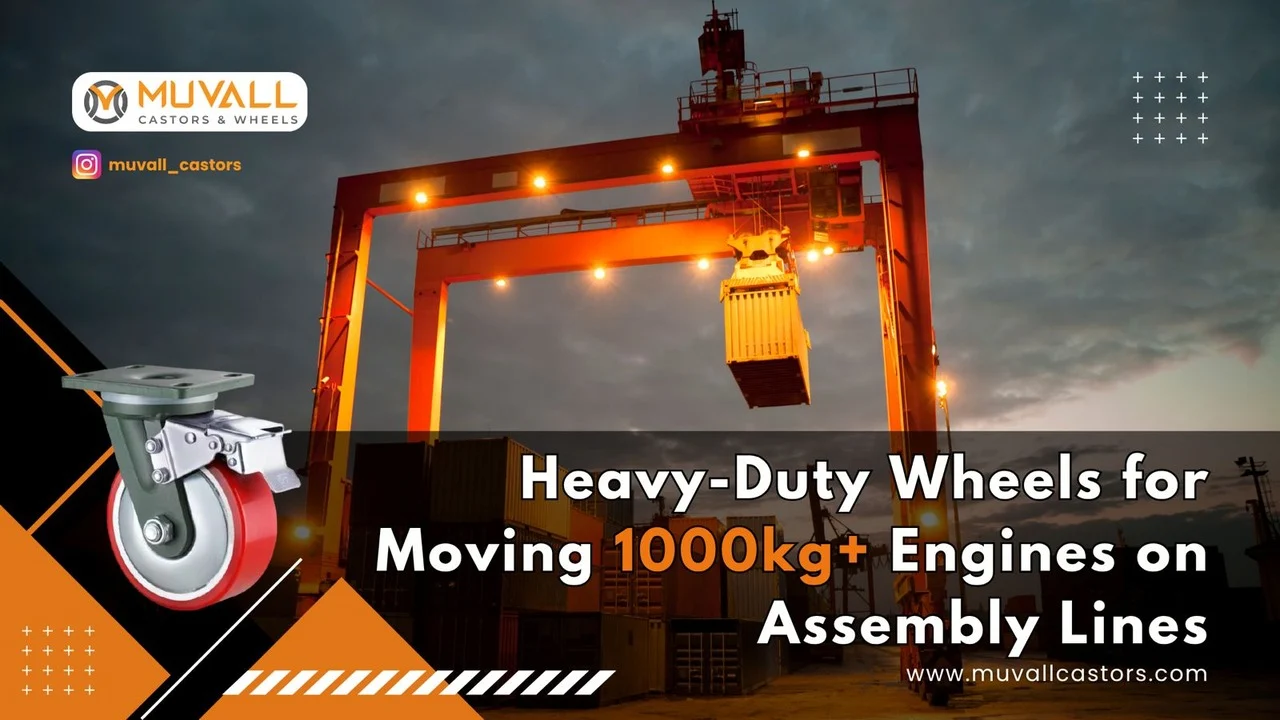
What Heavy-Duty Wheels Do You Recommend for Moving Engines Weighing 1000 kg or More on an Automobile Assembly Line?
Moving a 1000 kg engine across an assembly line is one of the more demanding jobs you can ask a castor to do. The load is heavy, the shock loads when the engine is lowered onto the trolley are higher than the static load, the operators need to position the engine to within a few millimetres of the next station, and any failure has to happen almost never, because a castor giving way under a mounted powertrain is a serious incident.
This is why generic heavy-duty castors are often not good enough for automotive line use. Here's how the specification should actually be built.
Start by calculating the real per-wheel load
For assembly line trolleys moving heavy engines, the load calculation is:
- Engine weight: 1000 kg
- Engine trolley / skid / cradle weight: typically 150–250 kg
- Tooling and fixture weight: 50–100 kg
- Total static load: ~1200–1350 kg
Using the 3-wheel load assumption (only 3 of the 4 wheels carry meaningful load at any given moment, due to floor unevenness and frame flex):
- Static load per wheel: ~400–450 kg
Then apply a safety factor. For automotive assembly lines, the minimum is 2.5×, and 3.0× is preferable, because assembly environments include oil spills, dropped tools, weld spatter, and the regular shock loads that happen every time an engine is lowered into a cradle.
- Required per-wheel capacity: 1000–1350 kg
This single calculation rules out a large fraction of the castors sold in India, almost all pressed-steel brackets, all light-duty fabricated castors, and most generic "heavy-duty" castors marketed at 500 kg ratings. You are now in forged-steel territory.
The castor bracket: which Muvall series is right for engine work
Three Muvall heavy-duty series cover this load class. The right choice depends on the engine you're actually moving.
HMP: Heavy Duty (350–600 kg per castor)
Fabricated heavy steel bracket with PUCB or CNYB wheels in 100 mm, 150 mm, and 200 mm sizes. HMP is the right choice for engine sub-assemblies,
gearboxes, transmission housings, and lighter powertrain components, anything in the 800–1500 kg total trolley load range. At 200 × 50 mm PUCB, HMP gives 600 kg per castor, which is enough for the lower end of the engine spectrum.
HDP: Extra Heavy Duty, forged steel (600–1000 kg per castor)
Forged steel bracket with PUCB or CNYB wheels in 100 mm, 150 mm, and 200 mm sizes. HDP is the workhorse specification for standard automotive engine assembly lines. The HDP F/S/B 200 55 PUCB at 1000 kg per castor gives a 4-wheel set of 4000 kg static capacity, which on a 1200 kg trolley gives a real-world safety factor of approximately 3.3× on the 3-wheel-load assumption. That is the right number for an automotive line.
TTB: Super Heavy Duty, forged steel (1500–2000 kg per castor)
Forged steel bracket with tapered and thrust bearings in the swivel section, plus a 4-ball-bearing wheel. Available in 6" (150 × 75 mm) and 8" (200 × 75 mm) wheel sizes. TTB is the specification for full-size engines, full powertrains with transmission attached, heavy diesel engines, and any assembly line where reliability margin is more important than cost. The TTB B 200 80 PUCB at 2000 kg per castor takes you to a 4-wheel static capacity of 8000 kg, which gives effectively unlimited safety margin on a 1200 kg trolley, important when the same trolley sees thousands of cycles per year.]
For a typical petrol or diesel engine of 1000 kg, HDP is the default recommendation. Step up to TTB when the engine is heavier (commercial vehicle diesel, full powertrain), when shock loading is severe (engines lifted on/off frequently with imperfect cranes), or when the duty cycle is high enough that you want the wheel to outlast the trolley frame.
The wheel: cast iron core polyurethane (PUCB) or cast nylon (CNYB)
Both HMP, HDP, and TTB are available with two wheel materials, and the choice between them is determined by the floor:
Cast iron core polyurethane (PUCB): Polyurethane tread bonded to a cast iron centre. This is the right choice for modern automotive plants with epoxy or polished concrete floors, which is the majority of new and recently-refurbished facilities in India. PUCB gives you:
- Full load capacity (200 × 55 PUCB = 1000 kg in HDP, 200 × 75 PUCB = 2000 kg in TTB)
- Polyurethane tread that won't mark or chip epoxy
- Oil and chemical resistance: important given the realities of an engine line
- Lower noise than nylon or steel
- Better grip on smooth floors when the trolley is started or stopped
Cast nylon (CNYB): Solid cast nylon wheels. The right choice for bare concrete floors, older plants with damaged floors, and wash-down environments where polyurethane is at risk of degradation. CNYB gives you:
- Same load capacity as PUCB at the same size
- Higher chemical resistance to aggressive solvents
- Lower rolling resistance on smooth bare concrete
- The trade-off: harder, noisier, and not floor-friendly on epoxy
For most Indian auto plants commissioned in the last 10 years, OEM and Tier-1, PUCB on HDP forged brackets is the right default. Switch to CNYB only if your floor is bare concrete or if you have a specific chemical exposure that rules out PU.
Wheel size: don't go smaller than 150 mm
For engine movement, wheel diameter is non-negotiable:
- 150 mm (6") is the practical minimum, anything smaller struggles with expansion joints, dropped fasteners, and minor floor debris
- 200 mm (8") is preferred for 1000 kg+ engine work, lower rolling resistance, much lower push-pull force, better obstacle clearance, and (in HDP and TTB) higher load capacity per castor
- 200 mm with 75–80 mm tread width (TTB-class) is the right answer for full powertrains and any application where the operator effort is a known issue
A common mistake we see is specifying 100 mm or 125 mm castors to keep trolley height low. On a 1000 kg+ load, the rolling effort on a 100 mm wheel is so high that operators end up using pry bars or mechanical tugs to move the trolley, which defeats the purpose of having castors at all.
Braking and configuration
For an engine trolley, the configuration we'd recommend is:
- 2 fixed + 2 swivel-with-brake, with the swivels at the front (direction-of-travel end)
- The two swivels fitted with the brake variant (suffix B in our SKU codes, e.g. HDP B 200 55 PUCB)
- If the trolley moves on or near any sloped floor, all four castors should have brakes
This gives straight-line tracking when the trolley is moving along the line and a firm park when the engine is being worked on.
Summary specifications you can put on a drawing
For a typical 1000 kg automotive engine trolley on an epoxy-floor assembly line, here are three defensible specifications at three price-and-margin points. Pick the one that matches your duty cycle and reliability requirement.
Specification A: Standard line, 1000 kg engine, normal duty cycle (HDP):
- 2× HDP F 200 55 PUCB (fixed, 200×55 mm PUCB wheel, 1000 kg each)
- 2× HDP B 200 55 PUCB (swivel with brake, 200×55 mm PUCB wheel, 1000 kg each)
- 4-wheel total static capacity: 4000 kg
- Real-world safety factor on a 1200 kg trolley: ~3.3× on 3-wheel load
- Plate size: 140×110 mm; hole pitch: 110×74 mm (fixed) / 112×76 mm (swivel/brake)
Specification B: Heavy engine or high-cycle line (TTB):
- 2× TTB F 200 80 PUCB (fixed, 200×75 mm PUCB wheel, 2000 kg each)
- 2× TTB B 200 80 PUCB (swivel with brake, 200×75 mm PUCB wheel, 2000 kg each)
- 4-wheel total static capacity: 8000 kg
- Real-world safety factor on a 1200 kg trolley: ~6.6× on 3-wheel load
- Plate size: 182×134 mm; hole pitch: 146×86 mm
Specification C: Sub-assembly trolley, smaller engine components (HMP):
- 2× HMP F 200 45 PUCB (fixed, 200×50 mm PUCB wheel, 600 kg each)
- 2× HMP B 200 45 PUCB (swivel with brake, 200×50 mm PUCB wheel, 600 kg each)
- 4-wheel total static capacity: 2400 kg
- Suitable for trolleys carrying gearboxes, cylinder heads, or sub-assemblies up to ~800 kg
If you have a specific bolt pattern your trolley frame is already drilled for, send us the dimensions and we'll match them, all three series have plate options that cover the standard Indian fabrication patterns.
A note on testing and traceability
For automotive line use, especially for Tier-1 suppliers working to OEM quality standards, ask your castor supplier for:
- Material test certificate
- Static load test report
- Conformance to relevant IS / DIN standards for the wheel tread
- A declared safety factor (it should be stated explicitly, not buried in small print)
Muvall provides a Quality Conformance Certificate and supplier MTCs for all HDP and TTB specifications on request. The 4-ball-bearing wheel design and tapered-thrust bearing swivel head in TTB are specifically engineered for the kind of duty cycles that automotive assembly lines see.
Bottom line
For engines of 1000 kg and above, the right specification is HDP forged-steel castors with 200 mm PUCB wheels in a 2-fixed-plus-2-swivel-with-brake configuration. Step up to TTB for heavier engines, full powertrains, or high-cycle lines where reliability margin matters more than cost. Drop to HMP only for sub-assembly work below 800 kg total trolley load.
Don't compromise on wheel diameter to save trolley height, and don't accept pressed-steel castors in this load class regardless of what the spec sheet claims.
If you want a specific Muvall specification mapped against your engine weight, cradle, and floor type, send us the numbers and we'll come back to you with a drawing and a quote within 24–48 hours.